Every Indian kitchen in the Gulf runs on two or three oils, not one. The question is never “which oil is best” — it’s which oil for this dish, today. Here is the honest comparison, from a family that has pressed two of the three since 1965. We don’t press sunflower; we’ll still tell you what it’s good at.
The one-table answer
| Cold-pressed groundnut | Refined sunflower | Kachi ghani mustard | |
|---|---|---|---|
| Flavour | Gentle, nutty | Neutral | Pungent, sharp, warming |
| Smoke point | ~230°C | ~230°C (refined) | ~250°C |
| Best at | Deep-frying, everyday sabzi | Baking, dishes where oil should disappear | Tadka, pickles, fish, saag |
| Worst at | Dishes needing total neutrality | Anything needing character | Delicate desserts |
| Typical UAE price | Mid per litre | Low per litre | Mid-to-high per litre |
Read down the columns and the pattern is plain: sunflower is a blank page, groundnut is a workhorse with a voice, mustard is a flavour decision you make on purpose.
Deep-frying: groundnut, and it isn’t close
A samosa or a kachori spends ten to fifteen minutes in the oil. Whatever the oil is doing in that time, the pastry is recording it. Groundnut oil holds a long, low fry without breaking — it resists the slow decomposition that makes an old fry-oil taste of varnish, and it does it while contributing a faint, warm nuttiness that reads as “fried at a good shop” rather than “fried in something”.
That stability is the practical argument. The flavour carry-over is the culinary one: a kachori fried in groundnut oil tastes of its filling and its shell; the oil signs its name in the corner rather than across the middle of the page. Sunflower can fry — plenty of commercial kitchens use it because it is cheap — but it thins out over a long session and starts tasting flat, then tired. Mustard oil can deep-fry (its smoke point is the highest of the three) and in parts of North India it traditionally does, but everything that comes out of it tastes of mustard. For jalebi, that’s wrong. For fish pakora, it might be exactly right.
Re-use is where groundnut earns its price: strained through cloth once cooled, a groundnut fry-oil is good for another session or two of the same kind of food. Any fry-oil — every fry-oil — is finished when it darkens, smells sharp when merely warm, or foams around the food. Pour it out; no oil is worth an acrid pakora.
If you fry regularly, start with the crispy kachori or the masala vada and watch what the oil does across fifteen minutes. That’s the whole argument in one pan.
The neutral middle: what sunflower is actually for
An honest word for a seed we don’t press: sunflower oil is for disappearing. In a cake, in a mayonnaise, in a dish where the fat is structure rather than seasoning, neutrality is a feature, and refined sunflower delivers it at the lowest price on the shelf.
Two things to know when you buy it. First, nearly all supermarket sunflower oil is refined — heat, solvent extraction, bleaching, deodorising — which is precisely how it gets that neutrality. That’s a legitimate industrial process; it is also the opposite of what a cold press does, and it’s why sunflower has no aroma for a tadka to build on. We’ve written the longer version in refined vs cold-pressed. Second, neutrality cuts both ways: sunflower will never rescue a flat dish, because it has nothing to add. If your dal tastes thin, the oil was one of the places flavour could have come from — and didn’t.
So the fair verdict: keep sunflower for bakes and for dishes where you’d otherwise waste a characterful oil. Just don’t ask it to do a tadka’s job.
Mustard: the flavour decision
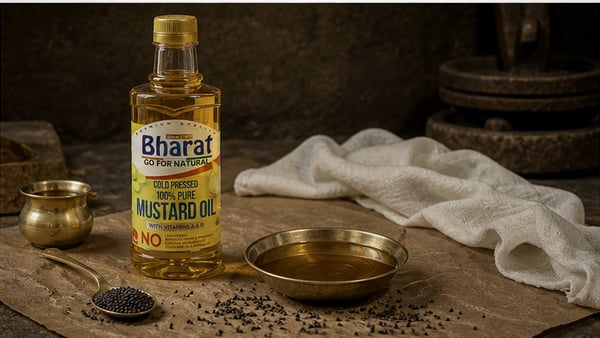
Mustard oil is not a background oil, and choosing it is the point. Kachi ghani mustard carries allyl isothiocyanate — the same family of pungency as wasabi — and the classic technique is to bring the oil to its first faint smoke, then let it settle before the spices go in. That first smoke softens the raw bite and leaves the warmth; skip it and the dish tastes aggressive, do it and the dish tastes of Punjab or Bengal, depending on what you do next.
That’s why mustard owns the dishes it owns: sarson da saag, Bengali fish, a proper achaar where the oil is the preservation system itself. The principles are in the sarson tadka essay; the short version is that mustard oil is a seasoning that happens to be a cooking medium, where sunflower is a cooking medium that refuses to be a seasoning.
Where mustard is wrong: anything delicate and sweet. A besan halwa in mustard oil is a category error. And while its smoke point is high, spending mustard oil on a neutral fry is a waste of exactly the thing you paid for.
The two-bottle kitchen
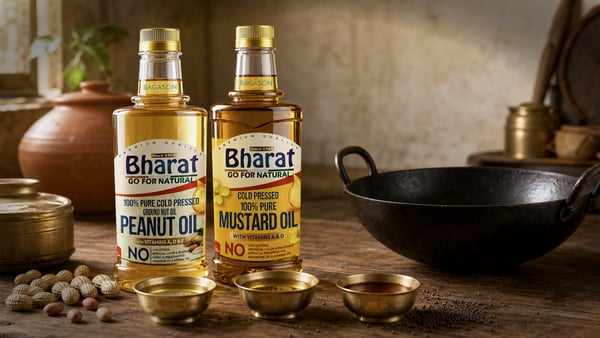
If your shelf holds two bottles, make them groundnut for volume and mustard for character — the fry-and-everyday oil, and the tadka-pickle-fish oil. Add sunflower only if you bake often. The regional thirds are sesame (South Indian tadka, dressings) and coconut (Kerala’s kitchen, entirely its own argument) — both pressed the same way, both on the oils page.
Whichever pair you choose, the rule that outlasts every comparison chart: match the oil to the dish’s heat and the dish’s voice. The seed does the rest.