Two words sit underneath the modern wellness phrase oil pulling. The texts that the practice comes from did not call it that. They called it gandusha and kavala — and the two are not the same thing, even though most articles on the internet treat them as one.
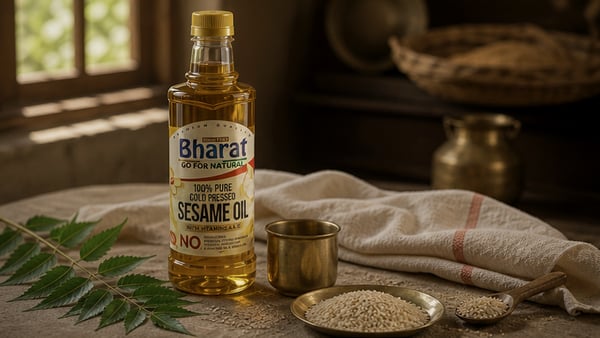
This piece is a careful reading of what the source actually says. We are an oil house, not a clinician. We make no therapeutic claims. What we can do is read the Sanskrit slowly, in roman, and tell you what the texts describe — because til taila, the sesame oil our grandfathers pressed and the oil our Rajasthan mill draws from black sesame seed today, is the oil those texts name.
Gandusha and kavala — the distinction
In the Caraka Samhita and the Sushruta Samhita — the two foundational compendia of Ayurveda, compiled in roughly the first millennium BCE through the early centuries CE — daily oral care sits inside a category called dinacharya, the daily routine. Two practices in that category use oil in the mouth.
Gandusha is the one where the mouth is filled completely with oil. The cheeks are full, the head is still, and you do not move the oil around. It sits. The texts describe holding it until the eyes water, the nose runs, and saliva fills the mouth around the oil — at which point it is spat out.
Kavala is the one where a smaller quantity of oil is taken in, and the mouth is moved actively. The oil is swished. The cheeks work it. The amount is roughly half the volume — enough to swish without strain — and the duration is shorter.
Modern “oil pulling,” as it is sold online, is closer to kavala than gandusha. Twenty minutes of swishing — the duration that wellness blogs commonly cite — is not in the source. The source describes the swishing as continuing until specific signs appear: a sense of fullness, eyes watering, saliva forming. The clock is the body’s, not the wristwatch’s.
This distinction matters because the texts assign different indications to each. Gandusha — the still, full-mouth practice — is described for conditions that are settled and chronic. Kavala — the active, partial-mouth practice — for the looser, more routine maintenance of the mouth and throat. To do one and call it the other is to do something the text does not exactly describe.
Why sesame oil
The Caraka and Sushruta texts name a small set of oils as suitable for these practices, and til taila — sesame oil — is the one most consistently named. The reason given in the source is twofold.
The first is the oil’s affinity with tissue. Sesame oil is the oil the Ayurveda texts return to most often across all snehana — oleation — procedures. From abhyanga (the full-body massage) to nasya (the nasal procedure) to gandusha, til taila is the default carrier oil. The texts describe it as deeply penetrating and as the oil that pacifies vata, the body’s wind element, more reliably than any other.
The second is taste and stability. Sesame oil has a balanced sweet-bitter character that the texts call kashaya-madhura, and it does not break down readily in the mouth at body temperature. Coconut oil is mentioned in some later commentaries; mustard oil is mentioned for specific conditions; ghee, separately, has its own indications. But the default — the oil a household would have kept on hand for daily use — is til.
That oil is what comes out of a wooden ghaani when you press black or white sesame seed slowly, without heat. The Rajasthan mill we operate today presses sesame the same way the texts assume: cold, slow, settled. The mother seed has not changed in 60 years, and not in 2,000.
What the texts say it does — and what they do not
Read carefully, the Caraka and Sushruta references describe these practices as supporting the mouth, the gums, the voice, the jaw, the taste buds. The lists of benefits are framed in terms specific to the mouth and throat — strength of the teeth, clarity of taste, firmness of the gum, lightness of the voice. The texts do not describe oil pulling as a systemic detox. They do not describe it as a cure for distant conditions. They do not promise it whitens teeth or treats diseases of the heart or the liver.
The modern wellness framing — that swishing oil pulls toxins from the bloodstream — is not in Caraka and is not in Sushruta. It is a 20th-century overlay. We mention this because the texts themselves are precise about what they claim, and we are not at liberty to be less precise on their behalf.
What the texts do describe, plainly, is a daily oral care practice that — read alongside dental scaling with twigs (danta-dhavana) and tongue scraping (jihva-nirlekhana) — formed part of a settled daily routine. It is in the same category as brushing your teeth: a hygiene habit, done daily, with cumulative effect on the mouth itself.
That is what the source says. No more, no less.
If you want to do it
Take a small spoon of cold-pressed sesame oil — about a teaspoon, not a tablespoon. The texts do not specify a volume in modern units, but a comfortable swish is the point, and a teaspoon allows the cheeks to work without strain.
Take it into the mouth on an empty stomach, in the morning, before brushing. Swish it gently — not aggressively. The Sanskrit verb the texts use suggests rolling, not churning. Five to ten minutes is sufficient for kavala by most modern Ayurvedic readings; longer is not better. When the oil has thinned and become slightly milky from saliva, spit it out — into a tissue and then a bin, not the sink, where it can settle in the trap.
Rinse with warm water. Brush.
Do this for a week, then for a month. The effect — if there is one — is on the mouth: the gum, the tongue, the breath when you wake. The texts do not promise anything systemic and neither do we.
What we leave to the vaidya
A practising Ayurvedic physician — a vaidya — would correct three things in this piece. They would say the choice between gandusha and kavala depends on the constitution of the individual. They would say the duration depends on the season. They would say the oil itself can be medicated, not plain, for specific conditions.
We are not arguing with any of that. A vaidya reads the texts inside a clinical practice; we read them inside an oil house. Our claim is narrow: the practice the modern internet calls oil pulling has a real source, the source names til taila, and the oil the source names is the oil we have pressed in this family for 60 years.
If you are using sesame oil in your mouth on the strength of a wellness blog, use the right oil. Use cold-pressed, kachi ghani til taila — sesame oil that has been pressed below 40 °C from raw, untoasted seed. The toasted, deep-amber sesame oil sold for East Asian cooking is a different product and is not what the texts describe. The light-amber, gently nutty oil from a wooden ghaani is what they meant.
Read the texts before the wellness blog. The texts are careful. They earned the right to be quiet about what they claim.
Since 1965. Unchanged on purpose.