Punjab · Mustard oil
Sarson da Saag
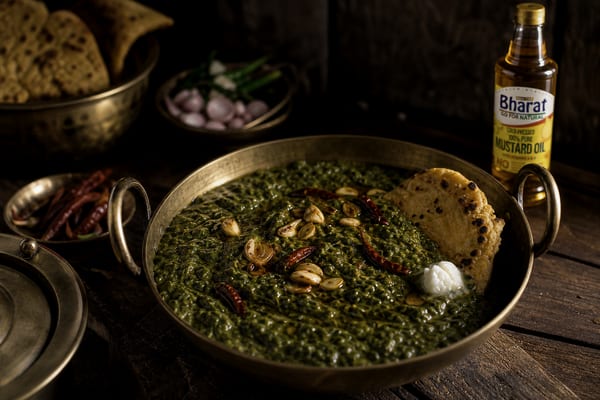
Punjab's winter staple — mustard greens slow-cooked to velvet, finished with a roaring mustard oil tadka of garlic, red chillies, and hing.
Ingredients
- 500 g sarson (mustard greens)
- 200 g bathua (lamb's quarters / goosefoot) · or substitute with spinach
- 200 g palak (spinach)
- 4 green chillies
- 1 inch ginger
- 8 garlic cloves
- 1 large onion
- 2 tbsp maize flour (makki ka atta)
- 1 tbsp ghee
- 3 tbsp Bharat mustard oil
- 4 dried red chillies
- 1 pinch hing (asafoetida)
- salt
- 2 tbsp butter or malai (cream)
The dish that winter waits for
Punjab’s winter runs from November through February, and in every kitchen across the region, sarson da saag appears the moment the first mustard greens arrive at the market. The saag is never rushed — it is simmered until the greens surrender entirely, then hand-mashed to a rough velvet. The texture should be rustic, not puréed. The maize flour gives it body. The mustard oil tadka on top is not optional — it is the dish.
The right mustard oil matters here. A cold-pressed mustard oil brings its own pungency, its own heat, and a depth that refined oil simply cannot carry. When the garlic and red chillies hit the hot oil, the kitchen fills with the unmistakable signal that saag is on the table.
The greens
- Wash the sarson, bathua, and palak thoroughly. Mustard greens trap soil in their stems — rinse in three changes of water.
- Bring a large pot of salted water to a rolling boil. Add the greens and green chillies. Cook uncovered for 15 minutes — the greens will collapse to a third of their volume.
- Drain, reserving a cup of the cooking water. Let the greens cool slightly.
- Mash by hand with a wooden masher or pulse twice in a food processor. The texture should be coarse — you want to see flecks of green, not a paste.
The slow cook
- In the same pot, heat the ghee. Add the ginger and half the garlic. Sauté for a minute.
- Add the onion and cook until translucent — about five minutes.
- Return the mashed greens to the pot. Add salt and ¼ cup of the reserved cooking water.
- Cook on the lowest possible heat, covered, for 45 minutes. Stir every ten minutes. The greens will darken, deepen, and release their full savour.
- Sprinkle the maize flour over the saag, stirring vigorously to incorporate. Cook for another five minutes. The saag will thicken to a soft, spoonable consistency. Add more reserved water if needed.
The tadka
This is the moment.
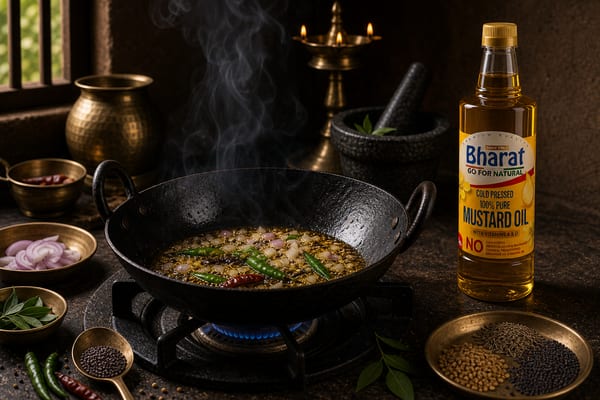
- Heat the Bharat mustard oil in a small tadka pan until it begins to smoke lightly — cold-pressed mustard oil must be heated to its smoking point to tame its raw bite.
- Add the dried red chillies and the remaining garlic. Let the garlic turn deep gold, not brown.
- Add the hing. It will bloom in seconds.
- Pour the entire tadka over the saag. Do not stir. Let it sit for two minutes — the oil will form a fragrant layer on top.
- Finish with butter or malai. Stir once at the table.
Notes from the kitchen
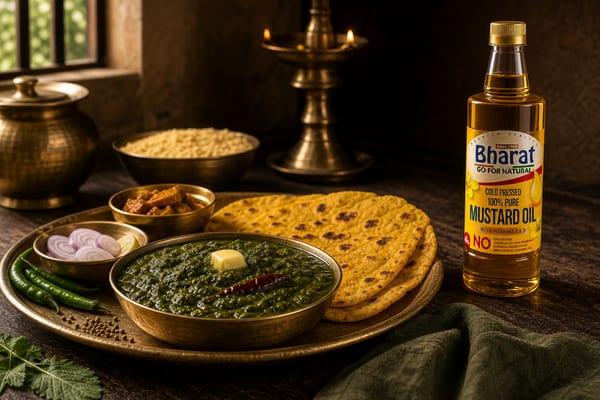
- Serve with makki di roti (maize flour flatbread), a wedge of white onion, and a squeeze of lime. In a Punjabi home, the roti is slathered with butter, and a spoonful of saag is placed in the centre of each roti before every bite.
- The saag tastes better the next day. The flavours marry overnight. Reheat with a splash of water and a fresh drizzle of Bharat mustard oil.
- If bathua is unavailable, double the spinach. The sarson must remain the dominant green.
- Freeze in portions — sarson da saag freezes beautifully for up to three months.
In the making
The oil, the heat, the finish.
The oil for this dish
Bharat Mustard Oil →
Drawn cold from the year's first mustard, amber and pungent.