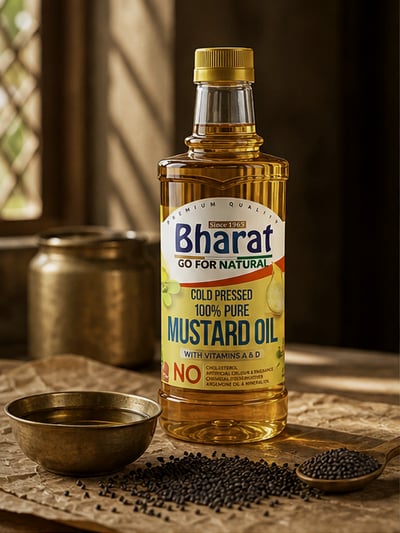
Cold-pressed · Single-origin · Since 1965
Mustard Oil
Sarson ka tel, pressed the way Bengal and the Doab have always pressed it.
- Smoke point
- 250°C
- Press temp
- < 30°C
- Source
- Rajasthan
- Shelf life
- 24 months
Best for
Available in
UAE delivery via Amazon.ae · India direct from the press
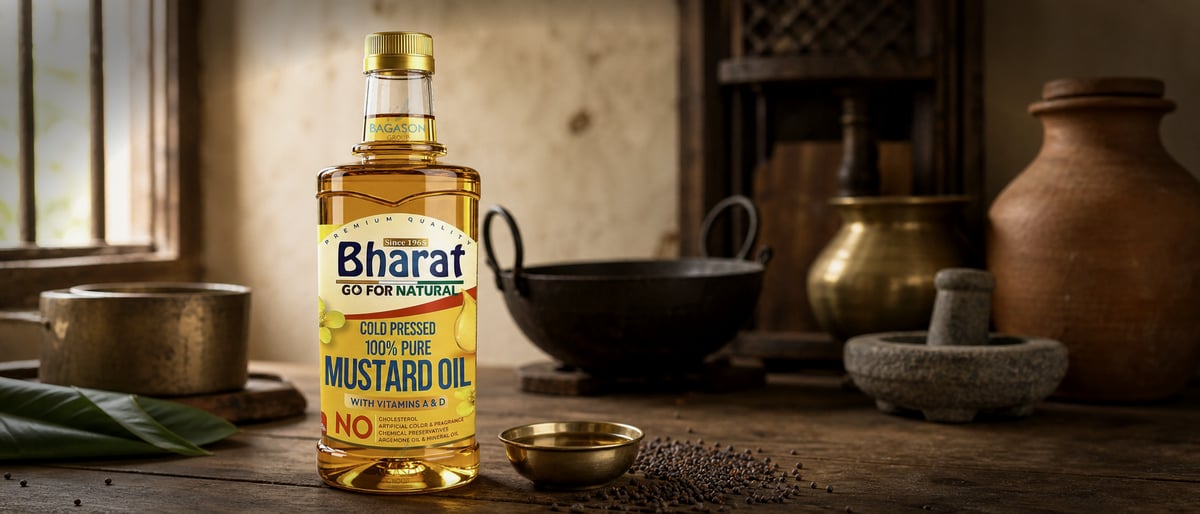
Drawn cold from the year’s first mustard, before heat can rob the oil of its pungency. The colour is amber and almost solid in winter — both are signs the press did its work right.
Sarson ka tel is the oil that defines Bengali and North Indian kitchens. It is also the oil most likely to be adulterated on the open market, blended with argemone or refined seed oils that compromise the very flavour it is bought for. We have refused this since the press began in 1965. What goes into the ghaani is mustard seed. What comes out is mustard oil. Nothing else.
The pungency is the test. Heat the oil to its first smoke before the tadka — kachi ghani asks for this — and the sharpness softens into the round, nutty depth that finishes a dal, a fish curry, or a winter achaar. If the oil does not bite at first, it has been refined out.
In Bengali and Punjabi kitchens, mustard oil is also the oil of celebration. The first drop of fish into a smoking kadhai, the slow finish on a katoris of aam ka achaar, the rub on a winter morning before a bath — sarson has always been more than a cooking oil. It is part of the household’s grammar.
What to expect from the bottle
Bharat mustard oil clouds in the cold. If you put a bottle in the refrigerator, the next morning it will be thick, amber, partly solid. This is the natural waxes and long-chain fatty acids in the oil — compounds with a higher melting point than the rest. Refined oils are put through winterisation precisely to strip these out, so they stay clear on a supermarket shelf. We do not winterise. The cloudiness is the proof that nothing has been removed.
Bring the bottle back to room temperature and the oil returns to clear amber. Pungency, flavour, behaviour in the kadhai — all unchanged. The fridge test is, in fact, one of four household checks for purity. We wrote up the others in the argemone adulteration guide.
What's in the bottle
The short of it
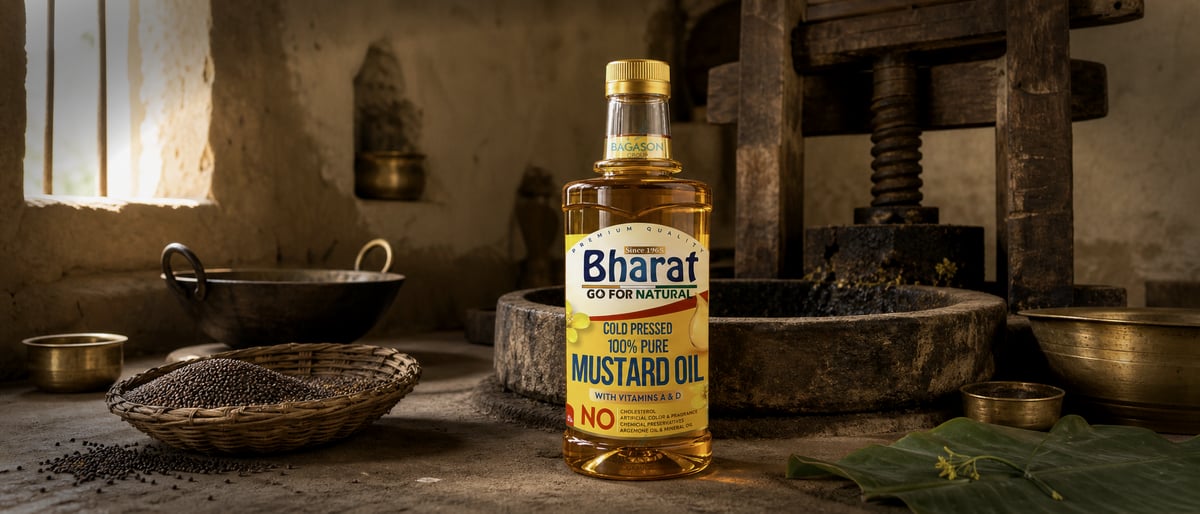
- Cold-pressed below 30°C in a wooden ghaani
- No refining, solvent, or deodorising step
- No argemone or mineral oil
- No artificial colour, fragrance, or preservative
- With added Vitamins A & D
Nutrition
Per serving
| Typical values | 1 tbsp (14 g) | Per 100 g |
|---|---|---|
| Energy | 126 kcal | 900 kcal |
| Total fat | 14 g | 100 g |
| Saturated fat | 1.7 g | 12 g |
| Monounsaturated | 8.4 g | 60 g |
| Polyunsaturated | 2.9 g | 21 g |
| Trans fat | 0 g | 0 g |
| Cholesterol | 0 mg | 0 mg |
Indicative values. Cold-pressed oil is whole fat — nothing added, nothing removed.
Cold-pressed vs refined
Same seed. A different bottle.
- Seed
- Ghaani · <30°C
- Oil
Nothing removed — aroma, antioxidants and flavour all kept.
- Seed
- Extract
- Degum
- Neutralise
- Bleach
- Deodorise
- Winterise
- Oil
Aroma, antioxidants and colour — stripped to a neutral base.
| Bharat — cold-pressed | Refined oil | |
|---|---|---|
| How it is drawn | Wooden ghaani, mechanical press | Hexane solvent extraction |
| Temperature | Below 30°C | Up to 240°C in deodorising |
| Processing | One step — press and filter | Six — degum, neutralise, bleach, deodorise, winterise |
| Aroma & flavour | The seed — kept whole | Neutralised, stripped |
| Natural antioxidants | Retained (tocopherols, phenolics) | Largely removed |
| Smoke point | 250°C — flavour intact | Higher — volatiles already gone |
| Shelf life | 24 months, kept cool and dark | ~2 years, shelf-stable |
| Best for | Tadka, finishing, everyday cooking | Industrial frying, neutral baking |
Refined oil is not bad — it is cheaper, paler, and steadier on a shelf. It is simply not the same oil that left the seed. Read the full comparison →
The detail
Specifications
- Smoke point
- 250°C
- Fat profile
- 60% MUFA / 21% PUFA / 12% SFA
- Press temperature
- < 30°C
- Source
- Rajasthan
- Shelf life
- 24 months
- Packaging
- Food-grade PET bottle
- Available sizes
- 500ml · 1L · 5L
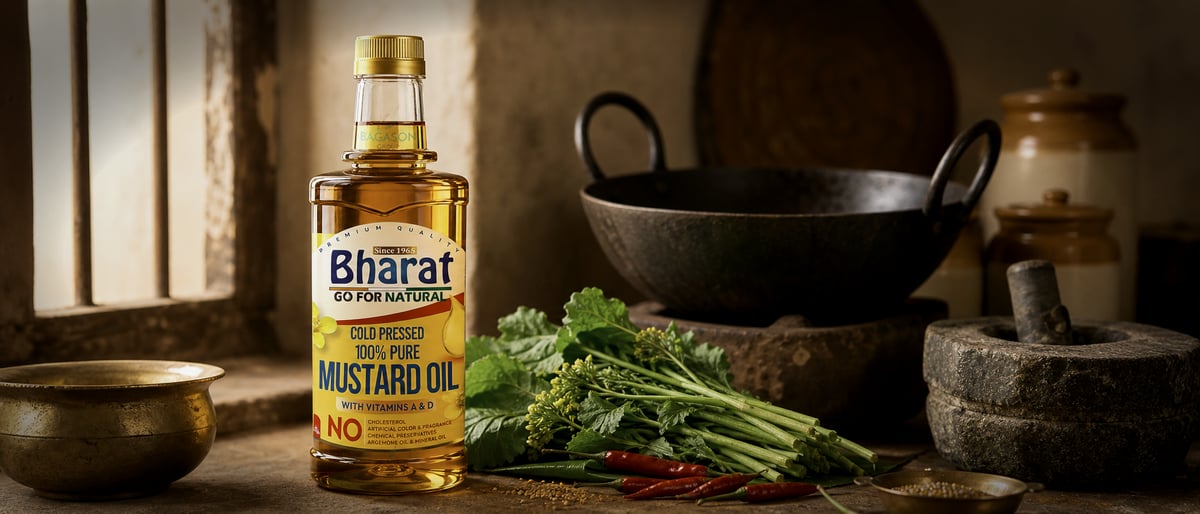
In the kitchen
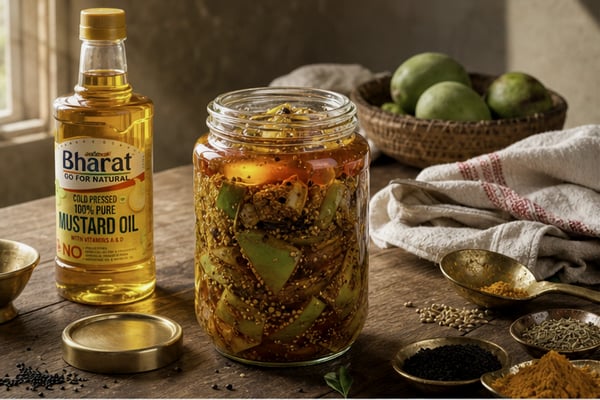
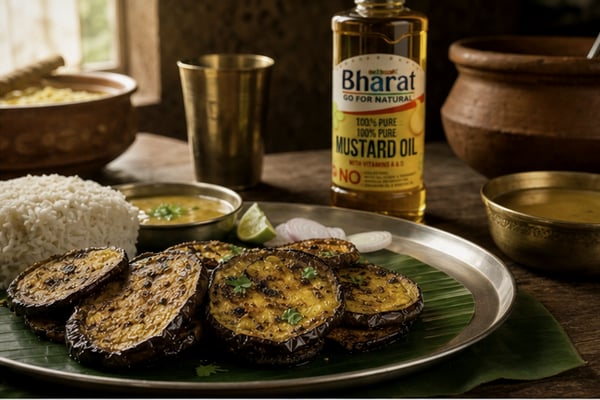
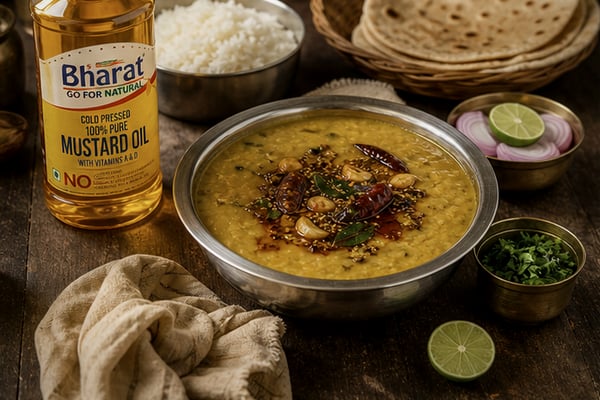
Cook with mustard
From the Journal
Reading on mustard
Storing Cold-Pressed Oil Through UAE Summer Heat
A kitchen guide to keeping mustard, sesame, groundnut and coconut oil fresh through Gulf summers — where to store the bottle, and what to watch for.
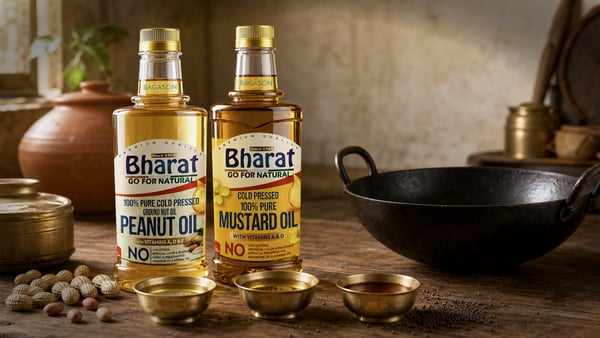
Groundnut vs sunflower vs mustard — which oil, for which pan?
The three bottles most Indian kitchens argue about, compared the way a press would compare them — by seed, by heat, and by what they do to the food.
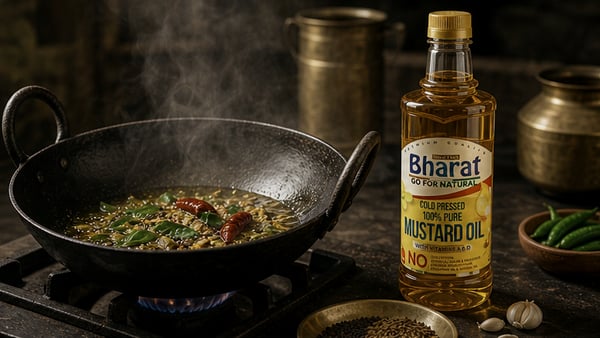
Sarson ka tel, the right way — four Bengali tadka principles
The first smoke, the second crackle, the third pour, the fourth rest. The Bengali way with mustard oil.
From the inbox
Questions we are asked
- What is the smoke point of Bharat mustard oil?
- 250°C. Cold-pressed oils have lower smoke points than refined oils because the volatile aromatic compounds — the very flavour you bought the oil for — have not been stripped.
- Is Bharat mustard oil refined?
- No. Bharat oils are cold-pressed in a wooden ghaani at temperatures below 30–40°C. There is no refining step, no solvent extraction, no deodorisation. The seed goes in, the oil comes out, nothing else.
- Where can I buy this oil?
- In the UAE, order on Amazon.ae. In India, WhatsApp the press directly or look for Bharat Oils at your local kirana. For hospitality and distribution enquiries, see our Trade page.
UAE
On Amazon.ae
Buy on Amazon.aeIndia
From the press
WhatsApp to orderTrade