Mustard oil is the most adulterated cooking oil in India. It always has been. The seed is expensive, the demand is constant, and the cheapest substitute — the oil pressed from a yellow-flowered weed called Argemone mexicana — is visually almost indistinguishable. The trouble is, argemone oil is poisonous. It contains an alkaloid called sanguinarine that causes epidemic dropsy: oedema, glaucoma, cardiac and respiratory failure. Mixed at five to ten per cent into mustard, it passes the visual test. It does not pass the chemical one.
The Delhi outbreak of August 1998 was the largest documented case. Several thousand people hospitalised, dozens of deaths. The state response was a tightening of FSSAI standards and a wave of public education that worked for a few years and then quietly stopped. Adulteration today is less brazen, but the seed-and-oil supply chain still allows it.
This is why the family press tests every batch. It is also why a household should know how to test its own bottle.
What FSSAI tests for, batch by batch
Before any of our mustard oil leaves the press, three numbers are read.
- Free fatty acid (FFA) content. A measure of how much the oil has begun to break down. Cold-pressed, freshly bottled, ours sits well below the FSSAI ceiling of 1.25%.
- Peroxide value (PV). A measure of oxidation — how much oxygen the oil has already drunk. Fresh oil tests near zero. An oil sitting open on a warm shelf will start to climb.
- Adulteration tests. Three named tests, one per common adulterant:
- Halphen test — detects cottonseed oil (a common blender). Mixes oil with sulphur in carbon disulphide; a red colour means cottonseed.
- UV fluorescence — detects mineral oil (a petroleum derivative used to dilute). Under UV light, mineral oil fluoresces; cold-pressed mustard does not.
- Bellier test — used on sesame oil, sometimes blended into mustard for cost. Specific colour reaction with hydrochloric acid plus furfural.
The chemistry is straightforward. The discipline is doing the tests on every batch and rejecting any that fail. The press has done this since 1965.
What a household can do, with what is in the kitchen
Three of the four tests below need nothing more than a dry glass and a few minutes. The fourth needs concentrated nitric acid — handle with care, adult supervision only, do not improvise.
Test 1 — The freeze test
Take two tablespoons of the oil into a clean glass and put it in the refrigerator overnight.
Pure cold-pressed mustard oil clouds and partially solidifies in the cold. The natural waxes and long-chain fatty acids in unrefined mustard have a higher melting point than the bottle’s other components. You will see a thick, opaque layer.
Argemone oil does not behave this way — it stays runny in the cold. So does the cheap soybean or palm oil that gets blended in. If your “mustard” oil refuses to thicken in the fridge, the bottle is suspect.
Test 2 — The sliding test
Drop a spoonful of the oil onto a clean, dry, slightly tilted glass plate. Watch how it moves.
Pure mustard oil is viscous. It will run, but slowly, leaving a thin amber film as it goes.
Argemone oil is thinner and slipperier. It runs faster, breaks into beads on the plate, and leaves a yellower trace. The difference is small but visible when the two are compared side by side.
Test 3 — The pungency test
Pure cold-pressed mustard oil bites the nose. Pour a small amount into a shallow saucer and inhale at six inches.
The bite — sharp, like wasabi, in the back of the sinuses — is the allyl isothiocyanate. It is the same compound that makes the tadka work. It is also the reason traditional achaar set in cold-pressed mustard oil keeps without a preservative.
A diluted mustard oil smells flat. A refined one smells of almost nothing. A heavy adulteration with argemone often has a slight, sweet, soapy smell that does not belong.
Test 4 — The nitric acid test (advanced)
This is the laboratory test FSSAI uses for argemone. It detects sanguinarine directly. We are including the method because households should know how, but please read the warning twice before you mix anything.
Warning. Concentrated nitric acid is a strong oxidising acid. It will burn skin, eyes, and clothing on contact. Work in a well-ventilated space, on a clean glass plate, wearing gloves and eye protection. Adult only. If you would not handle the acid for a school chemistry experiment, do not handle it for this.
Method.
- Take 5 ml of the mustard oil into a clean, dry test tube.
- Carefully add 5 ml of concentrated nitric acid along the inside wall of the tube — do not shake, do not mix.
- Let the two liquids settle for thirty seconds.
- Read the colour of the acid layer.
Result. A colourless or faint-yellow acid layer means the mustard oil is pure. An orange or red acid layer means sanguinarine is present — the oil has been adulterated with argemone. The reaction is specific; nothing else in a typical mustard oil bottle produces this colour.
If the colour is positive, dispose of the oil. Do not cook with it. Notify the seller. The FSSAI complaint line accepts photographs of the test as evidence.
What we promise about our bottle
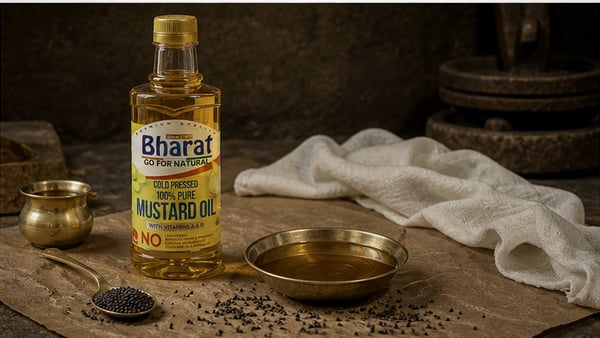
The mustard oil we press at the Rajasthan mill is from one seed and one batch, checked batch by batch — including the household-grade nitric acid check described above — before it goes into a 500 ml, 1 L, or 5 L bottle. The argemone result is zero, every time. We have refused this adulteration for sixty years and there is no reason that will change.
If you have done the household tests and your bottle does not behave as a Bharat bottle should, write to the press. We will replace it and we will want to know which shipment it came from. That is how we keep the press honest.
Since 1965. Unchanged on purpose.